
This is part 5 of a 5 part series. If you missed the start of the series, you can find part 1 HERE.
This whole series has been about helping you make nature a regular part of your life.The mental health benefits from it can be astounding.
But, can I be straight with you for a minute?
I know how some of these articles must sound.
Steve drives his campervan to a stunning waterfall and feels brilliant. Good for Steve.
And look, fair enough. That’s not exactly useful if you’re working full time, living in a city, or trying to hold a busy life together with whatever energy you’ve got left at the end of the day.
So this one’s the practical bit. No scenic drives. No dramatic locations. Just honest, workable ideas for getting more nature into your actual life — not the idealised version of it.
The dose is smaller than you think
This keeps coming up throughout this series and I’m going to keep saying it.
You don’t need hours.
Fifteen to thirty minutes in a natural setting produces measurable reductions in stress hormones, negative thinking, and anxiety. That’s it. Fifteen minutes. That’s a lunch break. It’s the long way home on foot. That’s twenty minutes in a park before the school run.
I know those minutes aren’t always easy to find. But for most of us, they’re there. If we decide they matter enough to protect them.
Start with what’s already near you
Before you plan anything ambitious, spend five minutes on this.
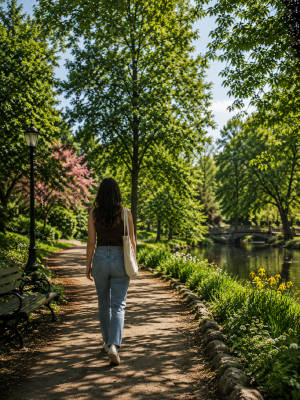 Identify the natural spaces within twenty minutes of where you live or work.
Most people are genuinely surprised. When you actually look, you tend to find:
- Parks with mature trees (urban ones count)
- Canal towpaths and riverside walks
- Coastal paths, if you’re anywhere near the coast
- Nature reserves and wildlife corridors (the UK has loads, many close to towns)
- Forestry Commission woodland (free, well-maintained, and all over the country)
- National Trust properties (many have free or low-cost access to their grounds)
The Woodland Trust and Forestry England websites both have tools that find woodland near you. There’s a decent chance you have a forest within a short drive that you’ve just never thought to visit.
Here’s the thing worth remembering.
Your nervous system doesn’t require a postcard view.
Green is green. Trees are trees. The research on stress reduction applies to a managed urban park as much as it does to a remote glen in the Highlands. The mechanism doesn’t care how Instagram-worthy it is.
Build it in. Don’t bolt it on.
This is where most people go wrong.
They treat nature as an extra. Something to squeeze in on top of everything else. Which means it’s always the first thing dropped when life gets busy.
Try folding it into what you already do instead.
- Walk a green route to work or the shops once a week, instead of the direct one.
- Take your lunch outside (a park bench counts, and it counts a lot).
- Swap one weekend morning of scrolling, for a short walk somewhere with trees or water.
- Plan one ‘nature hour’ per month. Not a big expedition. Just somewhere a bit different from your usual surroundings.
Replace something. Don’t add it onto everything else.
What about when life genuinely gets in the way?
It will. It always does.
Deadlines pile up. The weather turns awful. The kids need things. Everything needs things.
When that happens, go smaller rather than skipping it entirely.
Five minutes in the garden. Standing outside the back door with a cup of tea and no phone. Opening a window, sitting near it, listening.
The goal isn’t perfection.
The goal is a life where nature becomes a regular, low-effort part of how you manage your mental health. Not a luxury you reach for only after everything else has fallen apart.
Small and consistent beats big and occasional. Every time.
Your action for this week
This is the last action point in the series. I want to make it count.
Find one new place.
A natural space near you that you’ve never visited, or haven’t been to in a long time. It doesn’t need to be remarkable. It needs to be green.
Put it in your calendar.
Not “I’ll try to get out this week.” An actual appointment, with a time and a duration. Even twenty minutes.
Take the techniques with you.
Leave your headphones behind, try the 5-4-3-2-1 from Article 4, and do the before-and-after body scan from Article 2. You’ve got a complete toolkit now. Use it.
After that, the next step is to keep going. Not perfectly. Not every day. Consistently enough that nature stops being something you do occasionally and starts being something quietly woven into how you look after yourself.
You already know enough to start.
Quick summary
- Fifteen to thirty minutes produces real mental health benefits (you don’t need a full day out)
- Most people have usable natural spaces closer than they realise (parks, canal paths, and woodland all count)
- Build nature in as a replacement for something, not an addition to everything
- On difficult weeks, go smaller rather than skipping (five minutes outside counts more than none)
- The decision to step outside is available to you today, and that decision, made consistently, is where the real change happens
One last thing
I started this series telling you about a gift my daughter gave us, and an afternoon by a lake in Wiltshire that changed something for me.
Since then I’ve driven hundreds of miles looking for more of that feeling. Waterfalls, ruins, forests, wide open moorland under a big sky.
And what I’ve learned, mile after mile, is this.
The place matters less than the decision to go.
The decision to step away from the noise. Even briefly. The decision to stand still somewhere and let the world do its quiet work on you.
That decision is available to you today. Not next weekend. Not when things calm down. Today.
I hope something in this series helps you make it.
