
I get it a lot from people wanting to know how to practice mindfulness in nature:
“I’d love to slow down and connect with the world like you do. But I can’t seem to get out of my own head.”
Well, as you probably know if you’ve been here before, I’ve recently bought myself a cheap, used camera. And that works perfectly for me, because it gives my mind something to concentrate on.
And I know that not everyone wants a camera, or could even afford one if they did.
But, here’s the truth.
You don’t need one.
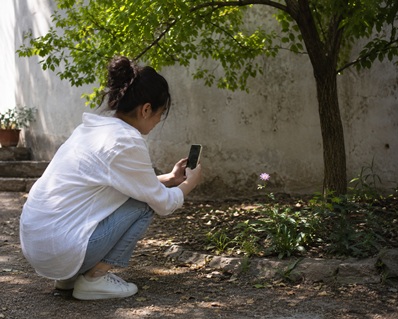 You already carry the only tool that matters. It’s probably in your hand right now 🙂 Of course, it’s your phone.
I know I always say, you should leave your phone at home when you’re trying to reset. But the problem isn’t really the phone.
It’s the notifications. The scroll. The little dots pulling your eyes down instead of up.
So here’s the trick.
Take your phone out. And turn Airplane mode on.
Suddenly, it’s not a distraction machine anymore. It’s a camera, a magnifying glass, and a notebook. It is your way in.
This is exactly how to practice mindfulness in nature without needing any fancy gear, or silent meditation retreats.
So, now we need a way to use it.
The 15-Minute Nature Scavenger Hunt
To get out of your head, you need a structured way to use your new tool. Try this simple mindfulness exercise.
Pick one small patch of ground. It can be a verge, a hedge, a patch of “waste” grass by a car park. Anywhere that’s easily accessible.
If you want, you can set a timer for 15 minutes, then look for these seven things:
- One flower you can’t name
- One leaf shape you’ve never noticed before
- Something growing in a crack in the pavement
- A plant with a smell (crush a leaf, gently, and sniff it)
- Something with more than one colour on it
- A seed head, or a bud about to open
- The smallest thing you can find
That’s it. Seven things. Fifteen minutes. No phone signal required.
Look for each one in turn, then photograph each one with your phone. Not for Instagram. Just for you.
What is Soft Fascination in nature?
There’s real science behind this simple game too. When your attention is effortlessly held by aesthetically pleasing, non-threatening natural elements, psychologists call it soft fascination.
This state allows your brain’s fatigued, focus to rest, making it one of the quickest, most effective ways to stop overthinking and quiet a busy mind.
Nature’s full of things that can gently pull you out of your own head. You don’t need to understand the psychological theory; you just need a patch of grass.
3 Free Apps to Identify Your Finds (Once You’re Back Online)
You don’t need these in the moment. Airplane mode first, remember. But afterwards, at home, feet up, these are worth having:
PlantNet: Remember that plant you didn’t recognise? PlantNet is free, it doesn’t have ads, and it was built by professional botanists. It’s brilliant at identifying wild plants specifically (though less useful for houseplants).
Seek by iNaturalist (not the full iNaturalist app): This is another great identification app. Again, it’s free, no account needed, and it’s built for exactly this kind of casual noticing. As well as identifying plants, it can also identify dozens of small animal and insect species as well. Great to get the kids involved with too.
iNaturalist (the full app, not Seek). I know I said to just use Seek, rather than the full app, but if you fall in love with this type of thing, and want your sightings to actually count towards real research, the main iNaturalist app lets you log your findings in global biodiversity databases.
Frequently Asked Questions
What if I can’t identify the things I find?
It doesn’t matter in the slightest. The act of noticing is the entire point. The name of the plant is just a bonus.
What if I only have five minutes?
Five minutes is more than enough. Just pick three things from the list instead of seven.
What if it’s raining?
It’s actually better! Wet leaves smell stronger, and rain makes natural colours look deeper and more saturated. Give it a try.
Do I need to go somewhere special?
No. A car park verge, your school run route, or your own back garden will do perfectly. Nature doesn’t check your postcode.
What if I feel silly crouching down to look at a weed?
You will feel silly—for about thirty seconds. Then, you’ll get so absorbed in what you’re looking at that you’ll forget to wonder if anyone’s watching.
Just try it once. Not every day. Don’t worry about making it a habit just yet.
Just try it once, today.
Your Phone on Airplane mode. Fifteen minutes. Seven things.
See what you find.
Steve
