
Why Standing Near Water Makes Everything Feel Better
This is part 3 in a 5 part series. If you missed the start, you can find it HERE
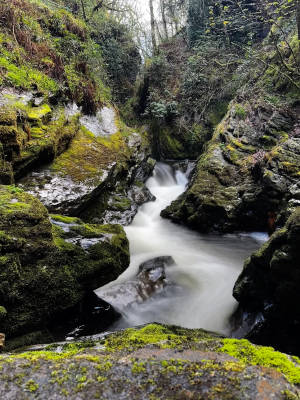 Whether it is a waterfall, loch, or gently meandering river – there’s a good reason water attracts us when we feel out of sorts.
The sounds and ambience around water is excellent for relieving stress.
I can’t count the number of times I have parked up the campervan, followed a short trail to a waterfall and simply stood there. No meditation, no breathing exercises, no trying to force mindfulness. Just standing there watching the water do its thing.
And every time, I’ve driven away feeling a little bit lighter.
For years I dismissed this as simply the beauty of waterfalls, and of course, they are stunning. But, now I know that there is much more going on.
How to use the blue mind effect, and nature for stress relief without meditating
Marine biologist Wallace J. Nichols, spent a number of years studying the impact of water on the human brain.
He came to the conclusion that being near, on, in, or by the water, induces a state of mild meditation – lowering our stress, anxiety and creating a subtle shift of consciousness which brings us into closer proximity to calm.
Nichols describes this state as the ‘blue mind’.
Compare this to our default state today, “over-stimulated, over-worked and mentally somewhere else”, and the appeal of the waterfall becomes clearer.
It’s thought that water produces negative ions. Charged particles in the air, which elevate serotonin levels and lower stress. They’re generated in their highest concentrations, by crashing waterfalls, waves and running rivers. So that lift you feel near water isn’t just in your head. It is a chemical reaction.
And forests and woodland?
Of course, water isn’t the only environment in nature that can help reduce stress.
I’ve pulled up the van beside ancient woodland across Britain and experienced exactly this phenomenon. A soothing silence that permeates within minutes of arriving within its confines.
As I mentioned last week, the trees emit compounds known as phytoncides, which we inhale directly, triggering a relaxing reaction in our bodies.
But, there is something more subtle too; an un-quantifiable sense of peace in old woodland. It could be in a Welsh valley, or on a Scottish hillside. A tree that has been standing for 300 years possesses a kind of steady permanence that provides an immediate sense of perspective to a troublesome day.
What about castle ruins?
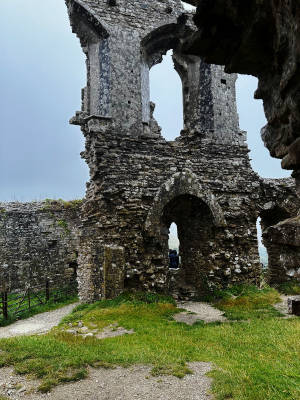 It might sound like an unusual suggestion, but bear with me.
I have spent countless hours rambling through castle ruins across the country, and can attest that they have a consistent tendency to make me feel at ease.
I think the reasons are to do with scale. Standing atop the ruins of a castle that has been in existence for around 800 years or so, and looking out across the very same vista that others once surveyed during dramatically different eras, tends to dwarf immediate concerns.
A trivial thought that seemed mammoth at 8am this morning, seems significantly less alarming from a windswept ruin, overlooking an amazing vista.
There’s also the quiet.
Ruins tend to be located in wide, open spaces where the silence can be profound. An escape from the incessant din of the modern world, is beneficial for an over stimulated nervous system and that’s also an observation supported by most therapist.
There is no need to travel far
I go to some incredible places. But, there is no need for a campervan and an open weekend to reap benefits from water.
Whether it is a canal towpath, the river on the edge of town, or even a pond in a local park, all these will work. The research doesn’t require wild, vast National Parks; Almost immediate stress relief requires only nature, and your focus upon it.
Your action for this week:
The task for this week is to find water in your local area, and make time to connect with it.
The setting doesn’t need to be a dramatic waterfall, or raging river; it can be anything at all. A pond, a brook in a local nature reserve, or even a town square fountain. Even watching a fish tank has been proven to have an uplifting affect, and the impact is a chemical reaction, irrespective of the scale of the water concerned.
When you’ve located your site, stay for a minimum of 15 minutes if you can; this is the time threshold identified as necessary to trigger a reduction in stress hormones.
Whilst you are there:
- Listen intently to the water. Treat it as you would an orchestral piece of music, dissecting and absorbing its nuances.
- Observe its ceaseless motion and any reflections it produces, allowing your eyes to rest where they will.
- Control your breathing and inhale for a slightly longer duration than you exhale.
- If finding water is genuinely not possible this week, try listening to a recording of rain or running water. The affect it triggers isn’t the same, but it’ll still provide a measure of calm. Consider it a temporary measure, or a means to bridge you through to better times.
This week’s summary:
- Surrounding yourself with water prompts a gentle state of meditation, also referred to by the term ‘blue mind‘.
- Negative ions released by moving water, raise levels of serotonin, the chemical thought to provide a sense of wellbeing.
- Old woodland, whether a formal garden, or wild setting, can be calming thanks to both phytoncides, and the sheer stillness it projects.
- Castle ruins, or open landscapes have much to offer in terms of perspective and an auditory break.
- Any form of water will suffice – from a tranquil canal, to the pond in a local park.
I’d love to hear your stories about when being in nature has helped you. You can contact me any time, by using the contact form, or even in the comments below 🙂
